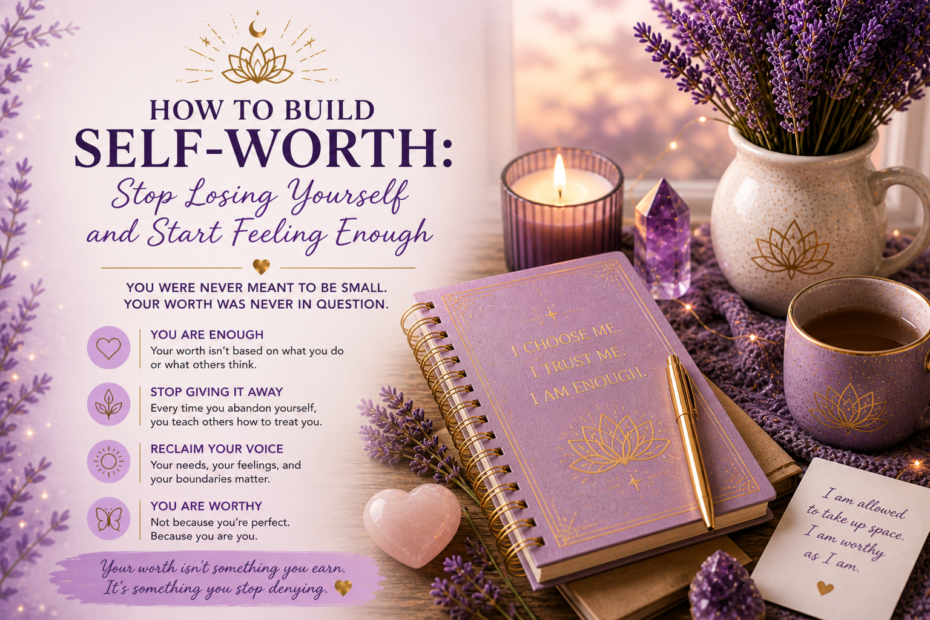
If you’ve ever wondered how to build self-worth, you’re not alone. Many people believe it’s something you gain over time—something that grows as your confidence increases or your life improves.
However, self-worth doesn’t come from becoming more. Instead, it comes from noticing where you’ve been slowly disconnecting from yourself—and choosing something different.
In reality, you don’t need to build your worth from scratch. You simply need to recognize where you’ve been giving it away.
You don’t start without worth. You start by believing you don’t have it.
It shows up in the small things first
Self-worth rarely disappears all at once. Instead, it fades gradually through patterns that seem small or insignificant at first.
For example, it can look like:
- Over-explaining yourself so you feel understood
- Second-guessing decisions you’ve already made
- Looking for reassurance before trusting yourself
At first, these habits don’t feel serious. However, over time, they begin to reshape how you see yourself.
As a result, trust weakens. Doubt becomes louder. Eventually, decisions feel heavier and more uncertain.
This is why understanding how to build self-worth begins with awareness rather than action.
You learned to measure your worth externally
These patterns usually develop for a reason. At some point, you learned that your value was connected to something outside of you.
For instance, it may have been linked to:
- How others responded to you
- Whether you were accepted or rejected
- How well you met expectations
Because of this, your sense of worth slowly shifted outward. Instead of feeling it internally, you began to look for it in other people.
When your worth depends on other people, it will always feel unstable.
Therefore, learning how to build self-worth means bringing that validation back to yourself.
Confidence is not the same as self-worth
At this point, it’s important to make a clear distinction.
Confidence relates to what you can do.
Self-worth relates to who you are.
Because of this, you can feel confident in certain areas of your life while still feeling uncertain within yourself.
For example, you might trust your abilities at work but still question your value in relationships or personal decisions.
This is why confidence alone doesn’t resolve deeper self-worth challenges.
You don’t need to prove your worth. You need to stop questioning it.
You lose self-worth through self-abandonment
Most of the time, self-worth isn’t lost in one moment. Instead, it’s lost through repeated self-abandonment.
This often shows up when you:
- Say yes when you actually mean no
- Ignore what you truly feel
- Prioritise others to avoid discomfort or conflict
Although these choices may feel easier in the moment, they come at a cost.
Each time, they reinforce the same internal message: your needs are less important.
Over time, this becomes your default way of relating to yourself.
As a result, rebuilding self-worth requires you to begin showing up for yourself differently.
Rebuilding self-worth starts with awareness
Rather than forcing confidence, the process begins by noticing your patterns.
Specifically, pay attention to where you:
Stay quiet when you want to speak.
Shrink when you want to expand.
Override yourself to maintain comfort.
Awareness is the moment things begin to shift.
Without awareness, these patterns continue automatically. However, once you notice them, you create the opportunity to respond differently.
Self-worth is built through what you allow
Importantly, self-worth is not only shaped by your thoughts—it is reflected in what you tolerate.
For example, what you accept, what you overlook, and what you continue to allow in your life all reinforce how you see yourself.
Over time, your standards communicate your self-worth more clearly than your thoughts ever will.
Therefore, what you allow becomes what you begin to believe you deserve.
This is why learning how to build self-worth often requires changing what you are willing to accept.
Shifting your relationship with yourself
At its core, self-worth is a relationship—the relationship you have with yourself.
And like any relationship, it is shaped through repeated interactions.
For instance, each day you either:
- Listen to yourself or ignore yourself
- Support yourself or criticise yourself
- Respect your needs or dismiss them
Although these moments may seem small, they create a powerful long-term impact.
Over time, they determine how safe, supported, and secure you feel within yourself.
That sense of internal safety is what self-worth is built on.
A different way to approach self-worth
You don’t need to become someone else to feel worthy.
You don’t need to prove anything, fix everything, or get it right all the time.
Instead, you need to start seeing yourself differently.
Not through comparison.
Not through approval.
But through awareness.
Your worth isn’t something you earn. It’s something you stop denying.
Final thoughts
Ultimately, learning how to build self-worth is not about adding something new to yourself. Instead, it is about removing the patterns that made you question yourself in the first place.
As you begin to notice where you are giving your power away, you naturally start to take it back.
Over time, your sense of worth becomes more stable, more internal, and far less dependent on anything outside of you.
Because the truth is, your worth was never missing.
You simply stopped seeing it.
← Return to Emotional Healing and Empowerment