Letting go is often talked about, but rarely understood in a practical way.
You may know something is no longer serving you—an emotion, a belief, a relationship, or even a version of yourself—yet still feel unable to release it.
As a result, the energy lingers. It shows up as tension, overthinking, emotional heaviness, or feeling stuck.
Learning how to let go and release energy is not about forcing yourself to move on. Instead, it is about creating the conditions that allow energy to naturally shift and move.
From that place, healing begins.
What does it mean to let go energetically?
Letting go is the process of releasing emotional and energetic attachments that are no longer aligned with who you are becoming.
This can include:
- Unprocessed emotions
- Outdated beliefs
- Past experiences that still carry emotional charge
- Attachments to outcomes or expectations
When energy is not processed, it does not disappear—it stays stored in the body and mind.
“What you do not release, you carry.”
Because of this, learning to release energy is essential for growth.
Why it can feel so difficult to let go
Even when something is no longer serving you, letting go can feel uncomfortable.
This happens for several reasons.
- Familiar patterns feel safe, even when they are limiting
- Emotional attachments create a sense of identity
- The mind seeks closure or certainty before releasing
As a result, you may hold on—not because it is right, but because it feels known.
However, holding on often creates more resistance than relief.
Signs you are holding onto energy
Sometimes, the clearest indication that something needs to be released is how it continues to show up.
- You replay situations or conversations repeatedly
- You feel emotionally triggered by similar patterns
- You struggle to move forward despite effort
- You feel mentally or emotionally heavy
- You find it difficult to be present
These are signals that energy is still active within you.
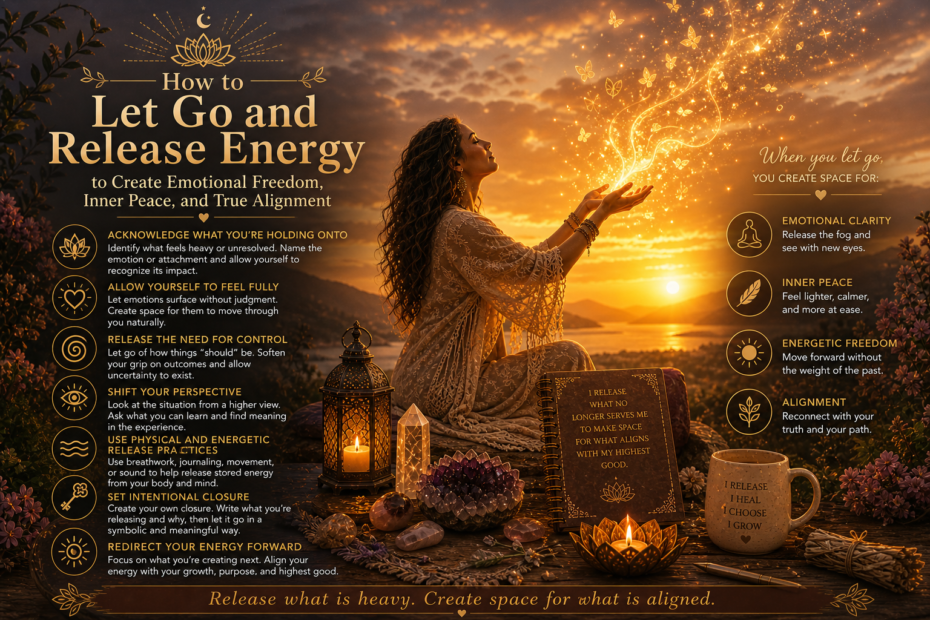
How to let go and release energy
Letting go is not a single moment—it is a process. The following steps will help you move through it intentionally:
1. Acknowledge what you are holding onto
- First, identify what feels heavy or unresolved
- Then, name the emotion or attachment honestly
- Finally, allow yourself to recognize its impact
You cannot release what you are avoiding.
2. Allow yourself to feel fully
- Instead of suppressing emotions, let them surface
- At the same time, avoid judging what you feel
- Over time, create space for emotions to move naturally
Feeling is a necessary part of releasing.
3. Release the need for control
- Notice where you are trying to control outcomes
- Then, soften your grip on how things “should” be
- Gradually, allow uncertainty to exist without resistance
Control often keeps energy stuck.
4. Shift your perspective
- Look at the situation from a broader perspective
- Then, ask what you can learn from the experience
- As a result, begin to see meaning instead of only pain
Perspective creates space for release.
5. Use physical and energetic release practices
- Practice breathwork to move stored energy
- Write and release through journaling
- Engage in movement such as walking or stretching
The body plays a key role in letting go.
6. Set intentional closure
- When needed, create your own sense of closure
- Write what you are releasing and why
- Symbolically let it go in a way that feels meaningful
Closure does not always come externally—you can create it.
7. Redirect your energy forward
- Focus on what you are creating next
- Shift attention toward growth and alignment
- Continue choosing thoughts and actions that support your future
Energy flows where your attention goes.
What happens when you truly let go
When you release stored energy, you create space.
As a result, you may notice:
- More emotional clarity
- Less mental noise
- A sense of lightness or relief
- Greater presence and focus
This is not because everything changes externally—but because your internal state shifts.
Letting go is a practice
Letting go is not something you do once and never revisit.
Instead, it is an ongoing process of awareness, release, and realignment.
Each time you release something that no longer serves you, you make space for something new.
Over time, this becomes a way of living—not just a moment of healing.
Final reflection
Right now, there may be something you are holding onto.
However, you have the ability to release it.
Not by forcing it away—but by allowing it to move through you.
As you begin to let go, you create space for clarity, peace, and alignment.
Release what is heavy. Create space for what is aligned.