After awareness comes a deeper question:
“If I am not my patterns… then who am I?”
For many people, this is where the real work begins.
You may have already identified your patterns, begun healing old wounds, and even started letting go of what no longer serves you. However, without consciously creating something new, it is easy to fall back into familiar ways of being.
Learning how to reclaim yourself and create new patterns is about stepping into who you truly are—beyond conditioning, expectations, and past experiences.
This is where transformation becomes identity.
What it means to reclaim yourself
Reclaiming yourself is the process of reconnecting with your authentic identity—separate from the roles, beliefs, and patterns you have inherited or developed over time.
It involves:
- Recognizing what is truly yours versus what was conditioned
- Letting go of identities that no longer fit
- Choosing who you want to be moving forward
This is not about becoming someone new. Instead, it is about returning to who you have always been beneath the layers.
“You are not becoming someone else—you are remembering who you are.”
Why old patterns return
Even after doing deep inner work, old patterns can resurface.
This happens because familiarity is powerful. The brain and body are wired to return to what feels known—even when it is no longer aligned.
As a result, without intentional change, you may:
- Slip back into old behaviors
- Recreate familiar relationship dynamics
- Default to conditioned responses
Because of this, awareness alone is not enough. New patterns must be created consciously.
The importance of creating new patterns
Letting go creates space. However, what you fill that space with determines your future.
New patterns are built through consistent choices, not one-time decisions.
Over time, these choices shape:
- Your identity
- Your relationships
- Your emotional responses
- Your overall life direction
This is how change becomes lasting.
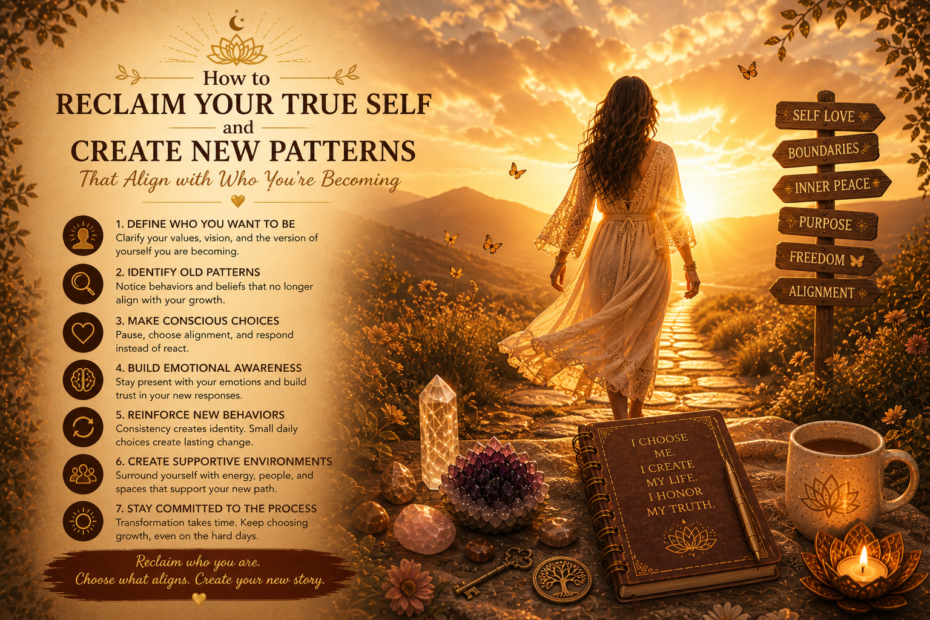
How to reclaim yourself and create new patterns
This process requires both self-awareness and intentional action. The following steps will guide you:
1. Define who you want to be
- First, reflect on the version of yourself you are becoming
- Then, identify the values that matter most to you
- Finally, clarify how you want to think, feel, and act
Clarity creates direction.
2. Identify patterns that no longer align
- Next, notice behaviors that conflict with your desired identity
- Then, observe where you default to old responses
- As a result, begin to separate from what no longer fits
You cannot change what you continue to repeat unconsciously.
3. Make conscious, aligned choices
- In the moment, pause before reacting automatically
- Then, choose responses that align with your values
- Even if it feels unfamiliar, stay committed to the new choice
Change happens in real-time decisions.
4. Build emotional awareness
- Notice how you feel as you shift patterns
- Allow discomfort without reverting back
- Over time, develop trust in your new responses
Growth often feels uncomfortable before it feels natural.
5. Reinforce new behaviors consistently
- Repeat aligned actions daily
- Track your progress and reflect regularly
- Celebrate small shifts as meaningful change
Consistency turns actions into identity.
6. Create supportive environments
- Surround yourself with influences that support your growth
- Reduce exposure to environments that reinforce old patterns
- Choose spaces that align with your future self
Your environment shapes your behavior more than you realize.
7. Stay committed to the process
- Expect moments of resistance or doubt
- Return to your intentions regularly
- Continue choosing alignment, even when it feels difficult
Transformation is built through repetition.
Becoming someone new can feel unfamiliar
As you begin to shift patterns, you may feel like you are stepping into the unknown.
This is normal.
For a period of time, your new behaviors may feel unnatural or forced. However, this is simply because they are not yet familiar.
Over time, what once felt uncomfortable becomes your new baseline.
“The unfamiliar is not wrong—it is simply new.”
Creating a new identity
Identity is not fixed—it is shaped by repeated thoughts, behaviors, and choices.
As you consistently act in alignment with your values, your identity begins to shift.
You are no longer trying to change—you are becoming.
This is where transformation becomes embodied.
Final reflection
You are not defined by your past patterns.
Instead, you are defined by the choices you make moving forward.
Each aligned decision is a step toward the life you are creating.
Over time, those steps become your new reality.
Reclaim who you are. Choose what aligns. Create the patterns that shape your future.