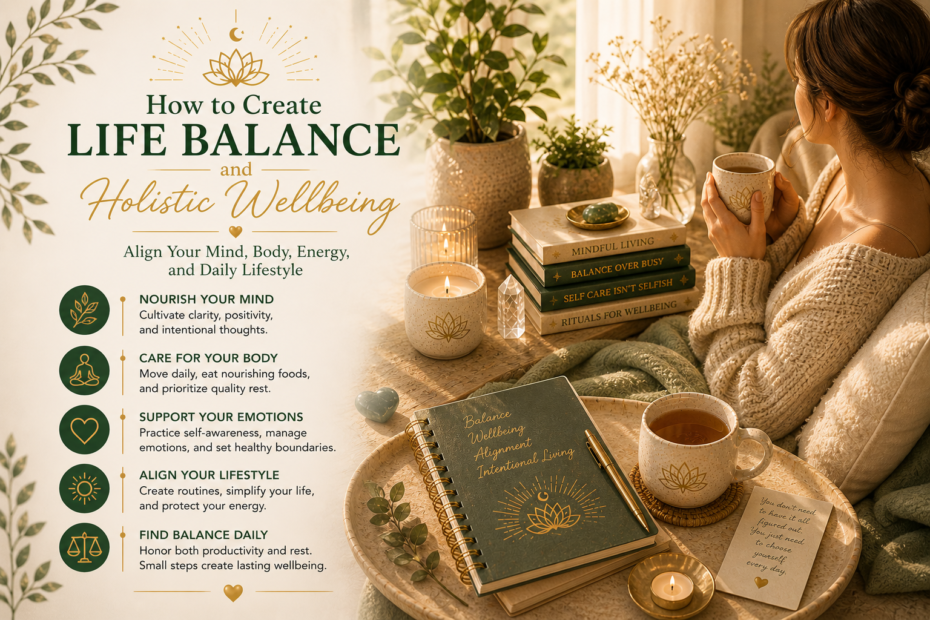
Many people are searching for balance, yet often approach it by trying to do more, fix more, or control more.
However, true life balance and holistic wellbeing are not created through constant effort. Instead, they come from alignment—between your mind, body, energy, and daily lifestyle.
When these areas are disconnected, you may feel overwhelmed, exhausted, or out of sync. On the other hand, when they are working together, life begins to feel more steady, intentional, and sustainable.
This is why creating balance is not about perfection—it is about integration.
What is life balance and holistic wellbeing?
Life balance is the ability to manage different areas of your life in a way that feels stable and supportive, rather than overwhelming.
Holistic wellbeing goes a step further by recognizing that your well-being is influenced by multiple interconnected areas, including:
- Mental clarity and mindset
- Emotional stability and regulation
- Physical health and energy
- Lifestyle habits and environment
Because these areas are connected, imbalance in one area often affects the others.
“Wellbeing is not one thing—it is the balance of everything working together.”
Why balance can feel difficult to maintain
At times, balance may feel out of reach. This is often because of how it is approached.
Many people try to create balance by:
- Overloading their schedule with productivity
- Ignoring rest and recovery
- Focusing on one area while neglecting others
As a result, this creates cycles of burnout followed by recovery, rather than steady balance.
Instead of trying to manage everything at once, it is more effective to focus on alignment across key areas.
Signs your life is out of balance
Awareness is the first step toward change. Often, imbalance shows up through consistent patterns.
- You feel constantly overwhelmed or drained
- You struggle to maintain routines
- You feel disconnected from yourself
- You move between extremes (overworking and burnout)
- You lack clarity or focus
These signals are not problems—they are indicators that something needs adjusting.
The core areas of holistic wellbeing
To create lasting balance, it is helpful to understand the core areas that influence your wellbeing.
Mental wellbeing: Your thoughts, focus, and clarity
Emotional wellbeing: Your ability to understand and regulate emotions
Physical wellbeing: Your energy levels, movement, and rest
Lifestyle alignment: How your daily habits support your life direction
When these areas are supported together, balance becomes more natural.
How to create life balance and holistic wellbeing
Balance is not something you achieve once—it is something you maintain through consistent choices.
1. Assess where you currently are
- First, reflect on each area of your wellbeing
- Then, identify where you feel supported and where you feel depleted
- Finally, choose one or two areas to focus on first
Awareness creates a starting point.
2. Simplify your priorities
- Instead of trying to do everything, focus on what matters most
- Reduce unnecessary commitments
- Create space in your schedule
Simplicity supports balance.
3. Create supportive daily habits
- Build routines that support your energy and focus
- Include time for both productivity and rest
- Stay consistent with small, manageable actions
Daily habits shape long-term wellbeing.
4. Manage your energy, not just your time
- Notice when you feel most focused and when you feel depleted
- Schedule tasks based on your energy levels
- Take breaks before you reach exhaustion
Energy management is key to sustainability.
5. Support your physical wellbeing
- Prioritize sleep and rest
- Incorporate movement into your day
- Nourish your body with supportive habits
Your physical state affects every other area of your life.
6. Strengthen emotional awareness
- Check in with how you feel regularly
- Allow space for emotions instead of suppressing them
- Respond intentionally rather than reacting automatically
Emotional balance supports mental clarity.
7. Create boundaries that protect your balance
- Be clear about your limits
- Say no when necessary
- Protect your time and energy
Boundaries maintain balance.
Balancing growth and rest
One of the most overlooked aspects of wellbeing is the balance between growth and rest.
While growth requires effort and action, it also requires recovery.
Without rest, progress becomes unsustainable. However, without growth, you may feel stagnant.
Because of this, both are essential.
“Growth requires effort. Balance requires rest. Sustainable wellbeing requires both.”
Creating a lifestyle that supports you
Your environment and daily lifestyle play a significant role in your overall balance.
Consider:
- Your physical space
- Your daily schedule
- Your digital environment
- Your social influences
When these elements support your wellbeing, it becomes easier to maintain balance.
Staying consistent over time
Balance is not something you perfect—it is something you return to.
There will be periods where things feel aligned, and others where adjustments are needed.
Instead of aiming for perfection, focus on returning to what supports you.
This approach creates long-term sustainability.
Final reflection
Life balance and holistic wellbeing are not about doing everything perfectly.
Instead, they are about creating a way of living that supports your mind, body, and energy consistently.
Through small, intentional changes, you can create a life that feels more grounded, aligned, and sustainable.
Create balance through alignment. Support your whole self. Build a life that sustains you.