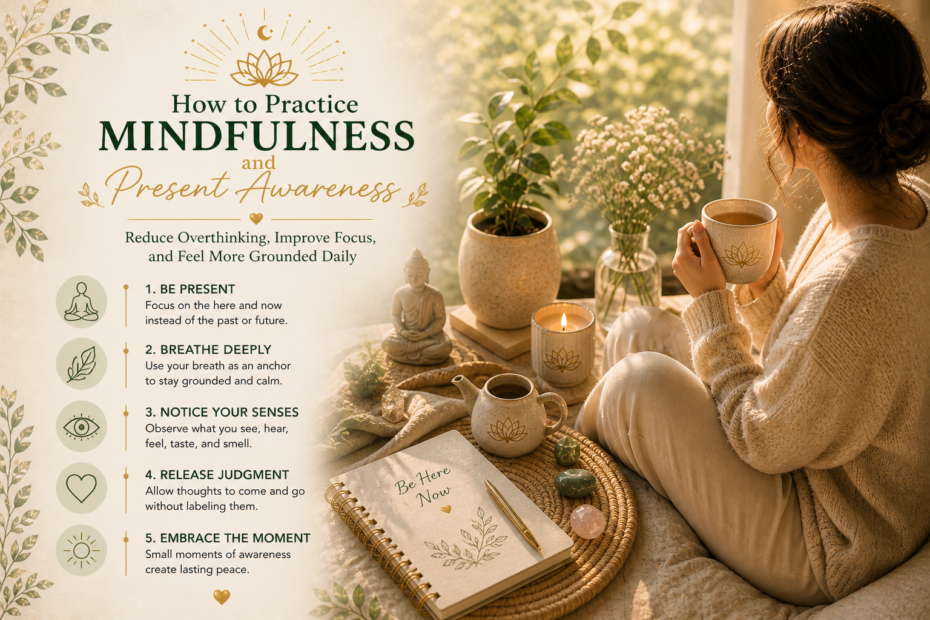
In a world that constantly pulls your attention in different directions, being present can feel difficult.
Your mind may move quickly from one thought to another—replaying the past, anticipating the future, or trying to manage everything at once.
As a result, it becomes easy to feel overwhelmed, distracted, or disconnected from the present moment.
This is where mindfulness and present awareness become essential.
Rather than trying to control your thoughts, mindfulness teaches you how to observe them—so you can return your attention to what is happening right now.
What is mindfulness and present awareness?
Mindfulness is the practice of paying attention to the present moment with awareness and without judgment.
Present awareness means being fully engaged in what you are doing, rather than being lost in thought.
Together, they allow you to:
- Stay grounded in the present moment
- Reduce overthinking and mental noise
- Respond more intentionally to situations
Instead of being controlled by your thoughts, you learn to observe them.
“You do not need to stop your thoughts—you need to stop being controlled by them.”
Why it is difficult to stay present
For many people, the mind naturally moves away from the present moment.
This happens because:
- The brain is wired to anticipate and analyze
- Modern environments constantly stimulate attention
- Habits of overthinking become automatic
Because of this, being present is not something that happens automatically—it is something you practice.
Signs you are not fully present
Awareness begins by noticing when your attention has shifted.
- You replay past situations repeatedly
- You worry about future outcomes
- You feel distracted or unfocused
- You struggle to enjoy the present moment
- You react quickly without thinking
These are not problems—they are opportunities to return to awareness.
How to practice mindfulness and present awareness
Mindfulness is not something you do once—it is something you integrate into your daily life.
1. Bring awareness to your breath
- Start by noticing your breathing
- Slow it down naturally
- Use your breath as an anchor to the present moment
Your breath is always available as a point of focus.
2. Observe your thoughts without reacting
- Notice thoughts as they arise
- Avoid judging or engaging with them immediately
- Allow them to pass without attaching meaning
Observation creates distance from overthinking.
3. Focus on what you are doing
- Give your full attention to the task at hand
- Reduce distractions when possible
- Engage fully with the present activity
Presence improves both clarity and performance.
4. Use your senses to ground yourself
- Notice what you can see, hear, and feel
- Bring attention to your surroundings
- Use sensory awareness to return to the present
Your senses connect you to the moment.
5. Pause throughout the day
- Take short moments to reset your attention
- Step away from constant activity
- Reconnect with your breath and awareness
Small pauses create space in your day.
6. Let go of the need to rush
- Notice when you are moving too quickly
- Slow down your pace when possible
- Focus on being present rather than finishing quickly
Slowing down increases awareness.
7. Practice consistently
- Integrate mindfulness into daily routines
- Be patient with your progress
- Return to awareness whenever you notice distraction
Consistency builds presence over time.
The benefits of mindfulness
As you practice mindfulness, you may begin to notice changes.
- Reduced stress and mental overwhelm
- Improved focus and clarity
- Greater emotional regulation
- Increased sense of calm
These benefits come from being more present—not from doing more.
Mindfulness in everyday life
Mindfulness is not limited to meditation—it can be applied to everyday activities.
For example:
- Eating without distractions
- Walking with awareness of your surroundings
- Listening fully during conversations
Each moment becomes an opportunity to practice.
Staying present in a busy world
Even in a fast-paced environment, mindfulness is possible.
Instead of trying to eliminate distractions completely, focus on how you respond to them.
Each time you notice your attention drifting, gently bring it back.
This repeated process strengthens your ability to stay present.
“Every time you return to the present, you strengthen your awareness.”
Final reflection
Mindfulness and present awareness are not about perfection—they are about practice.
Each moment offers an opportunity to return to the present.
Over time, this creates a greater sense of calm, clarity, and connection to your life.
Be present. Notice your thoughts. Return to the moment.