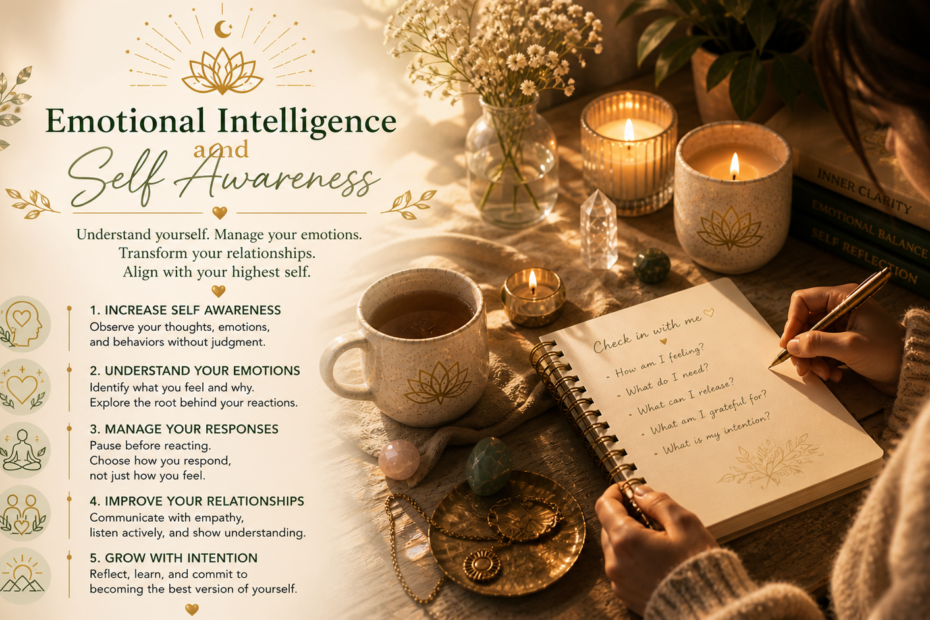
Many people focus on changing their external circumstances—relationships, routines, or environments—without first understanding what is happening internally.
However, lasting growth does not begin outside of you. It begins with awareness.
This is where emotional intelligence and self-awareness become essential.
When you understand your emotions, your reactions, and your patterns, you gain the ability to respond intentionally instead of reacting automatically.
From that place, everything begins to shift—your decisions, your relationships, and your overall sense of clarity.
What is emotional intelligence?
Emotional intelligence is the ability to recognize, understand, and manage your emotions while also being aware of how they affect others.
It involves:
- Recognizing your emotional state in real time
- Understanding the cause of your reactions
- Managing your responses intentionally
- Responding to others with awareness and clarity
Rather than suppressing emotions, emotional intelligence allows you to work with them.
“Emotional intelligence is not about controlling your emotions—it is about understanding them.”
What is self-awareness?
Self-awareness is the foundation of emotional intelligence.
It is your ability to observe your thoughts, behaviors, and emotional responses without immediately reacting to them.
With self-awareness, you begin to notice:
- Your patterns and habits
- Your emotional triggers
- Your beliefs and assumptions
- Your strengths and areas for growth
Because of this, self-awareness creates the space needed for change.
Why emotional intelligence and self-awareness matter
Without awareness, most reactions are automatic.
You may respond based on past experiences, conditioned beliefs, or emotional triggers without realizing it.
As a result, this can lead to:
- Miscommunication in relationships
- Repeating the same patterns
- Difficulty managing emotions
- Feeling overwhelmed or reactive
However, when awareness increases, your ability to choose your response also increases.
This is where real growth happens.
Signs you may need to strengthen emotional intelligence
Sometimes, the need for emotional awareness shows up through challenges.
- You react quickly without thinking
- You feel overwhelmed by your emotions
- You struggle to communicate clearly
- You repeat the same conflicts in relationships
- You find it difficult to understand your own reactions
These are not failures—they are indicators of where awareness can grow.
How to build emotional intelligence and self-awareness
This is a skill that develops over time through consistent attention and practice.
1. Start by observing your emotions
- First, notice how you feel throughout the day
- Then, name the emotion as clearly as possible
- Finally, avoid judging the emotion as good or bad
Awareness begins with observation.
2. Identify your triggers
- Pay attention to situations that create strong reactions
- Then, ask what specifically caused the response
- Over time, look for patterns in your triggers
Triggers often point to deeper patterns.
3. Pause before reacting
- When you feel triggered, create a moment of space
- Take a breath before responding
- Allow yourself to choose your reaction
This pause is where change happens.
4. Reflect on your behavior
- After interactions, take time to reflect
- Ask what you did well and what could improve
- Use this awareness to guide future actions
Reflection strengthens awareness over time.
5. Understand the root of your emotions
- Look beyond the immediate situation
- Consider past experiences or beliefs influencing your reaction
- Explore what the emotion is trying to communicate
Emotions often carry deeper messages.
6. Improve how you communicate
- Express your thoughts clearly and calmly
- Avoid reacting from heightened emotion
- Listen actively to others without interrupting
Communication improves when awareness increases.
7. Practice consistently
- Apply these skills in daily situations
- Be patient with your progress
- Focus on gradual improvement
Growth comes from repetition, not perfection.
How emotional intelligence improves your life
As you develop emotional intelligence, you begin to notice meaningful changes.
You become more:
- Calm in challenging situations
- Clear in your communication
- Confident in your decisions
- Intentional in your responses
In addition, your relationships begin to improve because you respond with awareness rather than reaction.
The connection between awareness and alignment
Alignment is not possible without awareness.
When you are unaware of your thoughts and emotions, your actions are often disconnected from your intentions.
However, as awareness increases, your actions begin to reflect your values more consistently.
This is where emotional intelligence becomes a key part of personal growth.
“You cannot change what you are not aware of.”
Staying consistent with self-awareness
Like any skill, self-awareness requires practice.
To stay consistent:
- Check in with yourself regularly
- Reflect on your emotional responses
- Stay open to learning about yourself
Over time, this becomes a natural part of how you think and respond.
Final reflection
Emotional intelligence and self-awareness are not traits you either have or do not have—they are skills you build.
With consistent practice, you gain clarity, control, and a deeper understanding of yourself.
From that place, your actions become more intentional, your relationships become stronger, and your growth becomes sustainable.
Observe your emotions. Understand your patterns. Choose your response.