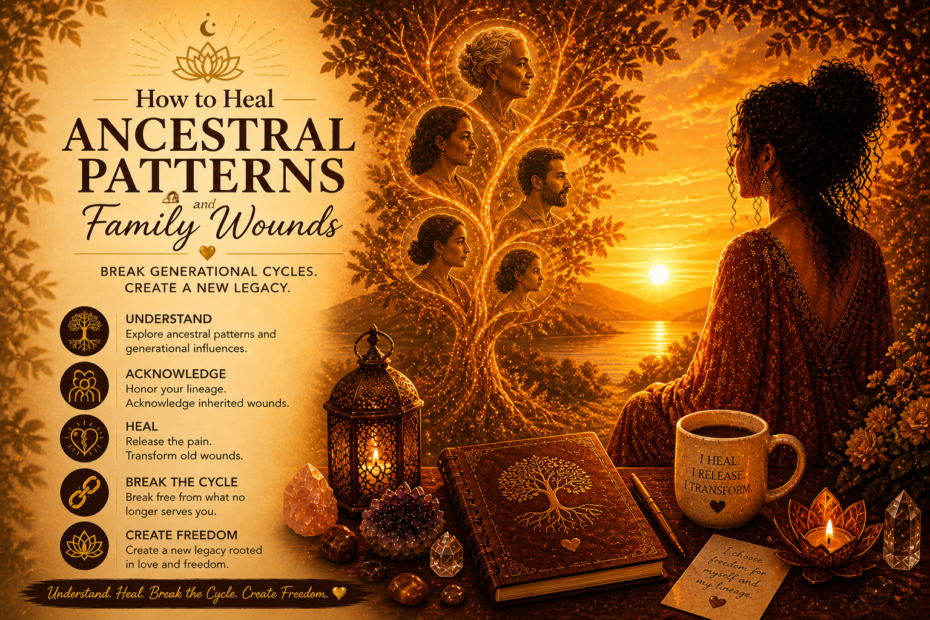
There comes a moment in many people’s lives when they begin to ask a deeper question:
“Why do I keep repeating the same patterns… even when I’m trying to change?”
If you’ve ever felt stuck in cycles of emotional pain, relationship struggles, or limiting beliefs that seem bigger than just your own experiences, you may be encountering something deeper—ancestral patterns and family wounds.
Learning how to heal ancestral patterns and family wounds is not about blaming your past. It is about understanding it, reclaiming your power, and consciously choosing a new path forward.
This is where true transformation begins.
What it means to heal ancestral patterns and family wounds
Ancestral patterns are inherited emotional responses, beliefs, and behaviors passed down through generations. Family wounds are the emotional imprints these patterns leave behind.
They often show up as:
- Repeated relationship dynamics
- Fear of abandonment or rejection
- Difficulty expressing emotions
- Patterns of self-sabotage
- Scarcity or fear around money and success
These patterns were often created as survival mechanisms.
“What helped your family survive may now be limiting how you live.”
Healing begins when you bring awareness to what was once unconscious.
Why generational cycles continue
Most people do not consciously choose their patterns—they inherit them.
Generational cycles continue because:
- Beliefs are passed down as “truth”
- Emotional wounds are left unprocessed
- Family dynamics reinforce familiar roles
- Fear keeps people from doing things differently
Without awareness, these patterns repeat automatically.
With awareness, they can be transformed.
Signs you are carrying ancestral patterns
If you’re unsure whether this applies to you, here are some clear indicators:
- You experience the same challenges repeatedly, especially in relationships
- You feel emotional reactions that seem deeper than the situation
- You struggle to break habits despite conscious effort
- You feel guilt or fear when trying to do things differently than your family
- You carry a strong sense of responsibility for others’ emotions
These are not flaws—they are invitations to heal.
How to heal ancestral patterns and family wounds
Healing is not instant, but it is absolutely possible with consistent, intentional work.
Here is a grounded, step-by-step approach:
1. Bring awareness to your patterns
- Write down recurring struggles in your life
- Look for connections to family behaviors or beliefs
- Notice your emotional triggers and where they come from
2. Trace the origin
- Reflect on how these patterns showed up in your parents or caregivers
- Consider generational experiences such as trauma, loss, or hardship
- Ask: “Where did this belief or behavior begin?”
3. Acknowledge and validate your experience
- Allow yourself to recognize the impact these patterns have had
- Stop minimizing your emotional experiences
- Give yourself permission to feel without judgment
4. Release inherited beliefs
- Identify beliefs that no longer serve you
- Challenge their validity
- Replace them with intentional, empowering beliefs
Example:
- Old: “I have to sacrifice myself to be loved.”
- New: “I am worthy of love without self-abandonment.”
5. Process emotional residue
- Journal regularly about your experiences
- Practice breathwork, meditation, or somatic release
- Allow emotions to move instead of suppressing them
Unprocessed emotions keep cycles alive.
6. Set boundaries that support healing
- Recognize where family dynamics reinforce unhealthy patterns
- Communicate your needs clearly
- Create distance where necessary for growth
Boundaries are not rejection—they are self-respect.
7. Create new patterns consciously
- Make choices aligned with your values, not your conditioning
- Practice new behaviors consistently
- Celebrate progress, even when it feels small
This is how transformation becomes permanent.
Breaking generational cycles is an act of courage
Healing ancestral patterns is not always easy.
It may challenge family norms, trigger discomfort, or create moments of doubt.
You may feel guilt for changing patterns that others accepted.
But breaking cycles is not betrayal.
“You are not abandoning your family—you are expanding what is possible for it.”
Your growth creates new pathways for future generations.
Creating a new legacy
When you commit to healing, you begin to build something new:
- Emotional awareness instead of suppression
- Healthy relationships instead of repeated dysfunction
- Self-worth instead of self-sacrifice
- Freedom instead of fear-based living
This is how legacies change—not through perfection, but through conscious choice.
Staying consistent in your healing journey
This work is not about quick fixes—it is about lasting transformation.
To stay grounded:
- Practice self-awareness daily
- Be patient with your progress
- Return to your tools when challenges arise
Healing happens in layers.
Final reflection
You carry both the wounds and the wisdom of your lineage.
Learning how to heal ancestral patterns and family wounds allows you to transform inherited pain into conscious power.
This is how cycles end.
This is how freedom begins.
Understand the past. Acknowledge the pain. Heal the wounds. Break the cycle. Create a new legacy.