Many people believe that change comes from motivation. However, motivation is inconsistent—it rises and falls depending on how you feel.
Because of this, relying on motivation alone often leads to starting and stopping, rather than creating lasting results.
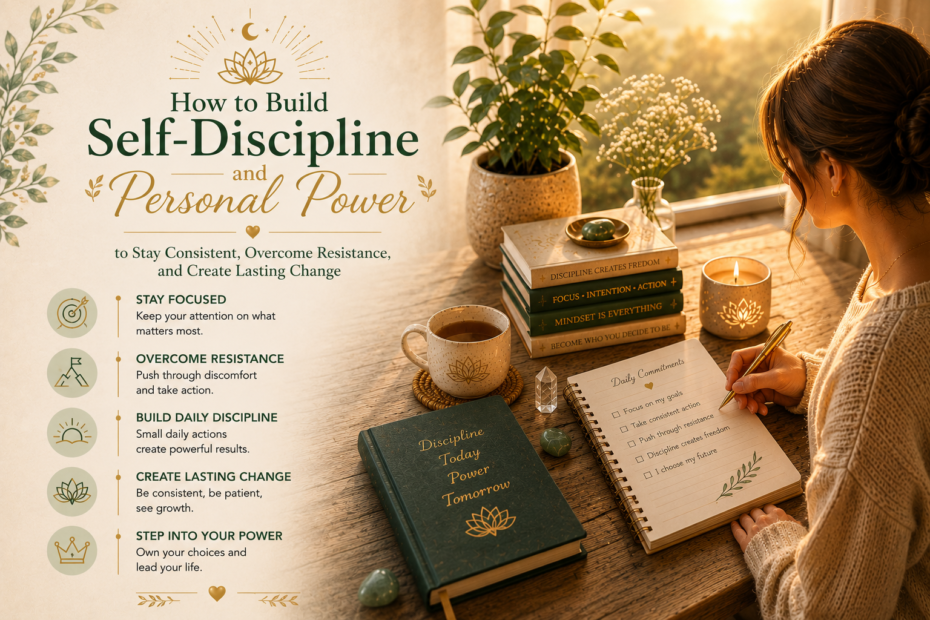
This is where self-discipline and personal power become essential.
Self-discipline allows you to follow through even when you do not feel like it. Personal power allows you to choose your actions intentionally, rather than reacting to impulses or external circumstances.
Together, they create consistency.
What is self-discipline?
Self-discipline is the ability to take action consistently, regardless of mood, motivation, or external conditions.
It is not about forcing yourself or being overly strict. Instead, it is about making aligned choices repeatedly.
Self-discipline involves:
- Following through on commitments
- Managing distractions and impulses
- Staying consistent with your habits
Over time, these actions build trust in yourself.
“Self-discipline is not about control—it is about commitment.”
What is personal power?
Personal power is your ability to make intentional choices, regardless of external influences.
It is the awareness that you are responsible for your actions, responses, and direction.
When you operate from personal power:
- You respond instead of react
- You take responsibility for your choices
- You act in alignment with your values
This is where consistency becomes possible.
Why self-discipline often feels difficult
At times, building discipline can feel challenging.
This is not because you lack ability—but because your brain is wired to seek comfort and avoid discomfort.
As a result, you may:
- Procrastinate on important tasks
- Choose short-term comfort over long-term growth
- Struggle to maintain consistency
However, these patterns can be changed with awareness and practice.
The connection between discipline and alignment
Self-discipline becomes easier when it is aligned with your values.
When your actions reflect what truly matters to you, consistency feels more natural.
Because of this, discipline is not just about forcing action—it is about choosing what aligns and following through.
How to build self-discipline and personal power
This process is built through small, consistent actions over time.
1. Define what matters most
- First, clarify your values and priorities
- Then, identify what you are working toward
- Finally, connect your daily actions to your long-term direction
Clarity strengthens commitment.
2. Start with small, consistent actions
- Focus on habits you can maintain daily
- Avoid overwhelming yourself with too many changes
- Build gradually over time
Consistency builds discipline.
3. Remove unnecessary distractions
- Identify what pulls your attention away
- Reduce or eliminate those distractions
- Create an environment that supports focus
Your environment shapes your behavior.
4. Follow through, even when it feels difficult
- Take action regardless of your mood
- Accept that discomfort is part of growth
- Focus on progress, not perfection
Discipline is built in moments of resistance.
5. Strengthen your awareness
- Notice when you are avoiding action
- Observe your thought patterns
- Choose your response intentionally
Awareness supports better decisions.
6. Build trust in yourself
- Keep small promises to yourself
- Follow through consistently
- Recognize your progress
Trust is built through repeated action.
7. Stay consistent over time
- Expect fluctuations in motivation
- Return to your habits consistently
- Focus on long-term progress
Consistency creates lasting change.
Overcoming resistance and procrastination
Resistance is a natural part of the process.
Instead of trying to eliminate it, focus on how you respond to it.
For example:
- Start with a small step instead of avoiding the task
- Break larger tasks into manageable actions
- Take action before overthinking
Action reduces resistance over time.
The long-term impact of discipline
As you build discipline, your actions become more consistent.
Over time, this leads to:
- Increased confidence
- Greater clarity and focus
- More aligned decision-making
- Stronger sense of control over your life
This is how personal power becomes visible.
Discipline without burnout
Self-discipline should not come at the expense of your wellbeing.
To maintain balance:
- Include rest and recovery in your routine
- Avoid pushing yourself beyond sustainable limits
- Adjust your approach when needed
Sustainable discipline supports long-term growth.
“True discipline is consistent, not extreme.”
Final reflection
Self-discipline and personal power are not traits you either have or do not have—they are skills you build.
Through consistent action, awareness, and intentional choices, you strengthen your ability to follow through.
Over time, this creates a life that reflects your values, your goals, and your direction.
Choose what matters. Take action consistently. Build the life you are creating.